Azerbaijan-Germany Diplomacy
Azerbaijani President Aliyev and German Leaders Deepen Bilateral Ties, Discuss Regional Peace and Energy Cooperation
Anonymous
Key Points
1
Ursula von der Leyen said to President Aliyev: "You have demonstrated personal leadership in promoting peace and cooperation in the region."
2
In the expanded meeting with President Steinmeier, Azerbaijan and Germany discussed gas supplies to Syria with the potential to expand to neighboring countries.
3
Aliyev reaffirmed Azerbaijan's support for Turkmenistan’s policy of neutrality and said this stance would continue.
4
Aliyev stated the goal of normalizing relations with the Council of Europe, but emphasized that the Council must take the first step.
5
During the Berlin welcome ceremony, the commander of the guard of honour reported to President Aliyev and Chancellor Merz before the national anthems were played.
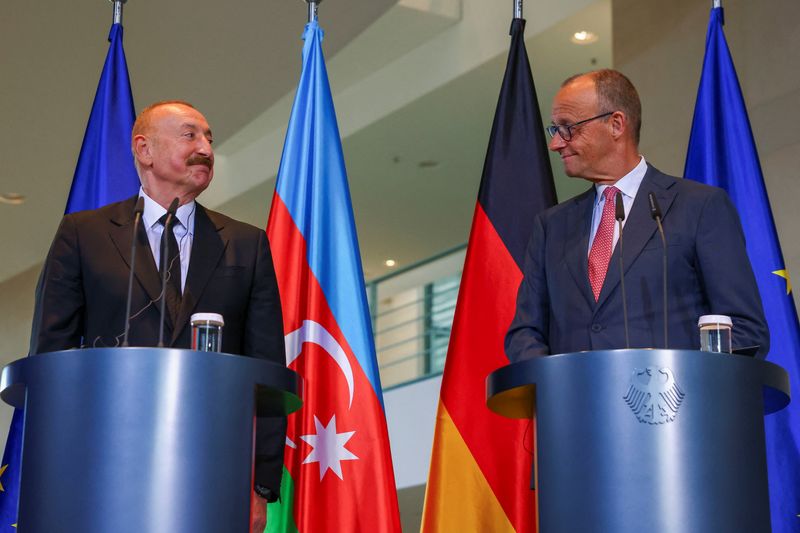
Azerbaijani President Ilham Aliyev arrived in Berlin for a high-profile state visit, where German Chancellor Friedrich Merz greeted him with a full military welcome ceremony. The two leaders reviewed the guard of honor as national anthems played before moving into one-on-one talks focused on energy, trade, and regional security. Euromaidan Press reported that Aliyev also confirmed a separate revelation: that secret talks between former German and Russian officials took place in Baku without Azerbaijani authorities' knowledge.
The Berlin meetings covered a broad agenda, from gas supply deals to diplomatic normalization with European institutions. Senior officials on both sides signaled strong momentum in Azerbaijani-German ties across multiple domains.
Merz and Aliyev Hold Talks on Energy and Trade
Chancellor Merz welcomed Aliyev with a formal ceremony at which the commander of the guard of honor reported directly to both leaders before the national anthems were played. The two then held a one-on-one meeting. They focused on deepening bilateral ties in energy, trade, and politics. Germany is one of Azerbaijan's most important partners in Europe across all three areas.
European Commission President Ursula von der Leyen also weighed in with praise. She told Aliyev: "You have demonstrated personal leadership in promoting peace and cooperation in the region." Her words underlined the high standing Baku currently holds in European diplomatic circles.
Gas Supplies to Syria and Neutrality Policy on the Table
In expanded talks with German President Frank-Walter Steinmeier, the two sides discussed gas supplies to Syria. They also talked about the potential to extend those supplies to neighboring countries. Energy cooperation emerged as one of the most concrete areas of agreement from the Berlin visit.
Aliyev also reaffirmed Azerbaijan's support for Turkmenistan's policy of neutrality, saying that stance would not change. Turkmenistan holds one of the world's largest natural gas reserves, making Azerbaijan's backing of its neutrality a significant signal to regional partners and energy markets alike.
Aliyev Confirms Secret German-Russian Baku Meetings
One of the most striking disclosures came when Aliyev confirmed that former senior German and Russian officials held clandestine talks in Baku. He said Azerbaijani authorities had no knowledge of the meeting at the time. Flight records first raised suspicions about the visits, according to WSAU.
Northland News Radio noted this was the first confirmation of those visits from an official source. The revelation adds a new layer to understanding Baku's role as a discreet diplomatic hub, even when its own government is kept out of the loop.
Aliyev Sets Conditions for Council of Europe Return
Aliyev said Azerbaijan wants to normalize its relations with the Council of Europe. However, he was direct about who must move first. He stated the Council of Europe must take the first step before Baku can move forward. Azerbaijan's membership was suspended following the 2023 military operation in Nagorno-Karabakh.
The condition reflects a broader pattern in Aliyev's Berlin messaging: engagement, but on Azerbaijan's terms. Across energy, security, and governance, the Berlin visit showed that Baku is positioning itself as an indispensable partner — while making clear it expects reciprocal respect from Western institutions.
Sentiment
Mostly PositiveNEGATIVENEUTRALPOSITIVE
Publishers
28
Articles
39
Reach
67
A
AnonymousAuthor


