Engine Blade Failure
Ryanair Engine Blade Fails Mid-Flight, Partially Sucking Passenger From Shattered Window
Key Points
Seven and a half minutes after takeoff, pilots received a high engine-vibration warning; about two minutes later the vibrations intensified, the pilots heard a loud bang, and the autopilot disengaged.
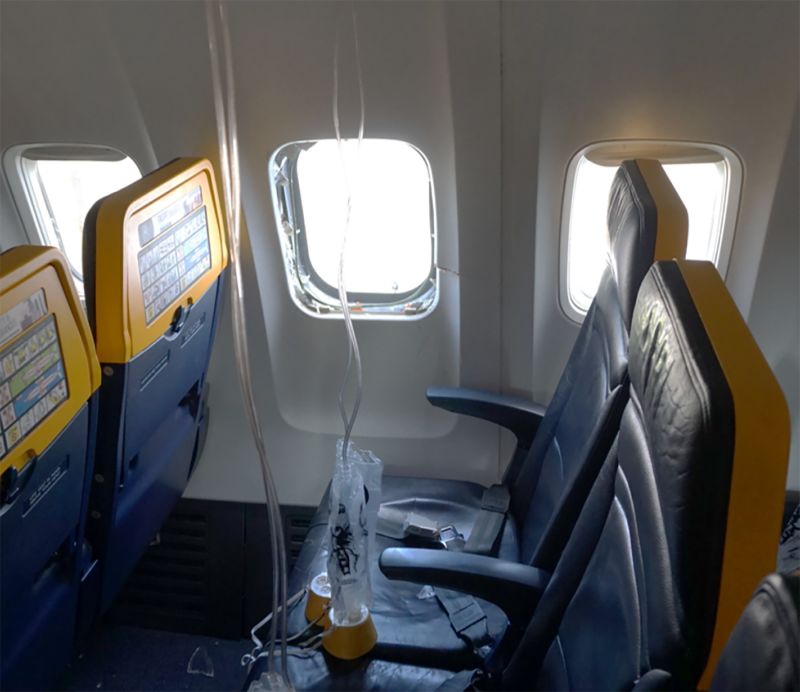
Engine fragments damaged the fuselage and the right horizontal stabilizer; debris tore through the engine area, shattered the row-11 window, dented the area near row 8, and damaged the tail.
The 61-year-old passenger seated in row 11 suffered neck and shoulder injuries and friction burns after being partially sucked out, before fellow passengers pulled him back inside the cabin.
The engine’s fan blades were inspected in May prior to the July flight, according to investigators.
Bird remains were recovered inside the damaged engine, and authorities noted four suspected bird strikes had been reported within the year.
A fan blade broke off a Ryanair Boeing 737-800 engine shortly after takeoff from Thessaloniki, Greece on July 10, sending debris into the fuselage and partially sucking a 61-year-old passenger out of a shattered window, according to a preliminary report from CNN. Fellow passengers pulled the man back inside before the plane made an emergency return to Thessaloniki.
The National Transportation Safety Board confirmed investigators found fatigue cracking in the broken blade and deformation in eight other blades. Bird remains were also found inside the engine, pointing to a possible bird strike as a contributing factor, The Sun Papers reported.
How a Fan Blade Tore Through the Aircraft
Seven and a half minutes after takeoff, the pilots got a high engine-vibration warning, according to CNN. About two minutes later, vibrations grew stronger, a loud bang rang out, and the autopilot shut off on its own.
Engine fragments hit the fuselage and the right horizontal stabilizer. Debris shattered the window at row 11, dented the fuselage near row 8, and damaged the plane's tail. The cabin lost pressure almost immediately, and oxygen masks dropped from the ceiling, Head Topics reported.
Passenger Partially Sucked Out, Pulled Back to Safety
The man seated in row 11 was pulled partway out of the window when the glass blew. He suffered neck and shoulder injuries along with friction burns, according to CNN. Other passengers grabbed him and pulled him back inside the cabin.
Video from inside the cabin showed passengers wearing oxygen masks amid visible panic. The aircraft returned safely to Thessaloniki after the window blew out. No fatalities were reported, The Sun Papers confirmed.
Fatigue Cracks, Bird Strikes, and Prior Inspection
Investigators found fatigue cracking — tiny stress fractures that grow over time — in the blade that broke free. Eight other blades on the same engine showed physical deformation, according to CNN. The engine is a CFM56-7B26, made by a joint venture between Safran and GE.
The fan blades had been inspected in May, just two months before the July 10 flight. Authorities also noted that four suspected bird strikes had been reported on the aircraft within the past year. Bird remains found inside the engine suggest a strike may have played a role, The Sun Papers reported.
Investigation Ongoing as Maintenance Questions Mount
The NTSB's preliminary report does not assign final blame. Investigators are still working to pin down the exact order of events, according to CNN. Key questions remain about whether the bird strike triggered the blade failure or whether the fatigue cracking was already critical before the flight.
The May inspection of the fan blades will likely face close scrutiny. Ryanair has not yet commented publicly on the findings. The investigation will carry broader maintenance implications for other Boeing 737-800 aircraft using the same CFM56-7B26 engine, Head Topics reported.
Sentiment
Mostly NegativePublishers
19
Articles
325
Reach
344