Semiconductor-Fueled Growth
South Korea's Q2 GDP Exceeds Forecasts, Boosted by Strong Semiconductor Exports
Anonymous
Key Points
1
South Korea’s exports hit a record 102.25 billion USD in June, up 70.9% year-over-year, with semiconductor shipments nearly tripling to a record 44.82 billion USD, underscoring the sector’s outsized role in Q2 growth.
2
Real GDI surged 15.6% year-on-year in the second quarter, the strongest rise since 1988, highlighting income gains accompanying export-led growth.
3
Bank of Korea official Dongwon Lee estimated that if the third- and fourth-quarter averages are minus 0.1% quarter-on-quarter, annual growth could reach about 3%, while noting risks from stalled Middle East ceasefire progress and potential oil-supply disruptions.
4
Breakdown of Q2 contributions shows domestic demand and net exports each adding 0.3 percentage points to quarter-on-quarter growth, with domestic demand contributing 2.2 percentage points and net exports 1.6 percentage points on a year-on-year basis.
5
Construction activity remained a weakness: construction investment fell 0.2% quarter-on-quarter and construction production declined about 1.9%, signaling sector-specific headwinds despite overall GDP momentum.
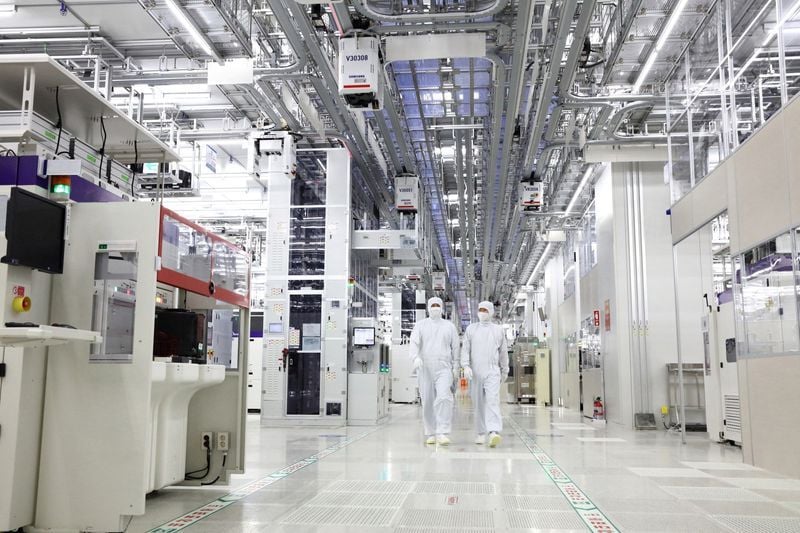
South Korea's economy grew 0.6% quarter-on-quarter in Q2, beating the 0.2% forecast and building on a strong 1.8% surge in Q1, according to Market Screener. A semiconductor export boom drove the outperformance, with chip shipments nearly tripling to a record $44.82 billion in June alone.
Total exports hit a record $102.25 billion in June, up 70.9% year-over-year, according to The State. The numbers confirm South Korea's economy is running well ahead of most analyst expectations heading into the second half of the year.
Semiconductors Carry South Korea's Economy Forward
Exports rose 1.4% in Q2, with semiconductors doing the heavy lifting, according to Charlotte Observer. Chip shipments nearly tripled to a record $44.82 billion in June. That single sector offset a dip in construction investment and higher energy costs. Semiconductors are computer chips — the components that power smartphones, cars, and AI systems — and South Korea is one of the world's biggest makers.
Real GDI — a measure of actual income earned in the economy — surged 15.6% year-on-year in Q2. That is the strongest rise since 1988, according to Miami Herald. It shows that export-led growth is translating into real income gains for the broader economy, not just headline GDP numbers.
Growth Was Balanced, Not Just an Export Story
The Q2 breakdown shows domestic demand and net exports each added 0.3 percentage points to quarter-on-quarter growth, according to Market Screener. On a year-on-year basis, domestic demand contributed 2.2 percentage points and net exports added 1.6 percentage points. Private consumption rose modestly, helped by government support measures and rising household wealth.
Not every sector shared in the gains. Construction investment fell 0.2% quarter-on-quarter, and construction production dropped roughly 1.9%, according to The State. That signals a real weak spot in the economy even as the headline numbers look strong.
Annual Growth Could Hit 3% — If Risks Stay Contained
Bank of Korea official Dongwon Lee said that if Q3 and Q4 averages just minus 0.1% each quarter, annual growth could still reach about 3%, according to Miami Herald. That would mark a strong recovery year for South Korea. He also flagged risks: stalled Middle East ceasefire talks and potential oil-supply disruptions could push energy costs higher and slow momentum.
The semiconductor boom is powerful but cyclical — meaning it can reverse quickly. Analysts say the key question is whether domestic demand can hold up without heavy government support once policy stimulus fades. Investors are now watching July inflation data closely to judge whether the Bank of Korea will act again on interest rates, according to Charlotte Observer.
South Korea's Broader 2026 Outlook Stays Positive
Looking further ahead, South Korea's economy grew 3.7% in Q2 on a year-on-year basis, slightly below the 3.8% recorded in Q1, according to Qazinform. That annual pace still exceeds the Bank of Korea's earlier forecasts. The first-half performance sets a high bar for the second half, particularly as base effects — the fact that last year's numbers were already strong — make big year-on-year gains harder to repeat.
The strong first half leaves South Korea well-positioned, but the path forward depends on chips staying in demand, oil prices staying manageable, and domestic consumers spending more. All three are uncertain. For now, the data tells a clear story: semiconductors are the engine, and the engine is running hot.
Sentiment
Mostly PositiveNEGATIVENEUTRALPOSITIVE
Publishers
22
Articles
74
Reach
96
A
AnonymousAuthor


