MISEDUCATION: DC Education Insights
Danielle Spencer Releases MISEDUCATION, a Novel Exploring Leadership and Equity in DC Public Education
Anonymous
Key Points
1
Danielle Spencer’s leadership background spans more than two decades across government, information technology, acquisitions, finance, and organizational management, which informs the novel’s perspective on institutional dynamics.
2
The novel explicitly states that its characters, dialogue, events, and narrative are fictionalized and not intended to portray or identify any specific individual, school, organization, or actual event.
3
The book is positioned with a Washington, D.C. setting, emphasizing its focus on the nation’s capital and the public education system there.
4
Coverage of the release spans multiple regional outlets, showing broad media interest beyond a single publication hub, including East Coast Sentinel, Wyoming News Headlines, Texas News Headlines, Jackson News Reporter, and Idaho News Updates.
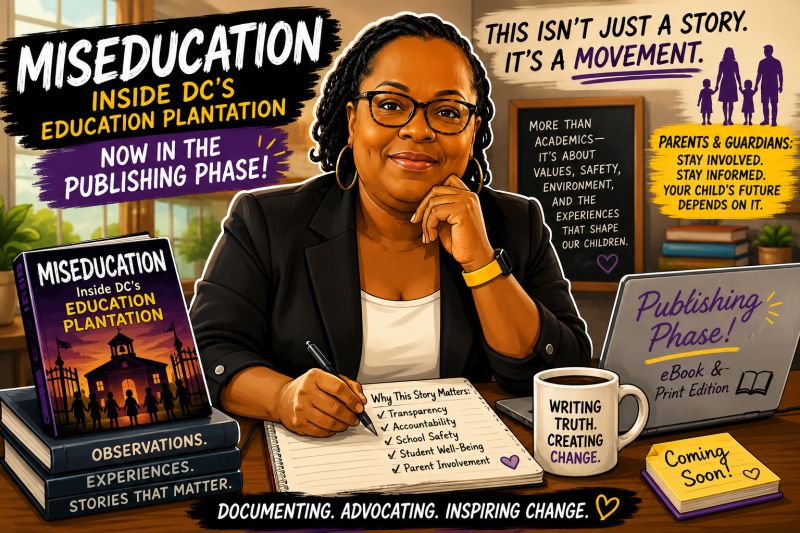
Author and federal whistleblower Danielle Spencer has released her new fiction novel, "MISEDUCATION: Inside DC's Education Plantation," according to Financial Content. The book digs into leadership failures, workplace culture, and equity problems inside public education — all set against a Washington, D.C. backdrop.
Spencer, who also wrote the Digital Assassins series, draws on more than two decades of work in government, technology, finance, and organizational management. She describes the novel as a tool to spark honest conversations about reform and accountability in public schools, according to WBOC.
A Novel Built from Two Decades of Public-Sector Work
Spencer's career spans government, information technology, acquisitions, and finance. That background shapes how the novel looks at bureaucracy and institutional power. Daily Tribune reports that the book explores how organizations fail the people inside them — and the students they serve.
The story is set in Washington, D.C., putting it squarely inside the nation's most-watched public education system. Spencer uses fiction to say things that raw data and policy reports often cannot. She frames the book as a mirror held up to systems many readers will recognize.
Fictional Characters, Real Institutional Problems on the Page
Spencer is clear that the novel is not about any real school, person, or event. All characters, dialogue, and events are fictionalized, according to WBOC. The disclaimer is deliberate. It gives Spencer room to explore sensitive topics — like accountability gaps and leadership failures — without pointing fingers at specific people.
That approach is common among insider fiction writers. By using invented names and settings, authors can tackle systemic problems more boldly. Readers familiar with public education will likely find the themes familiar even if the faces are not.
Whistleblower Background Adds Weight to Education Critique
Spencer is marketed as a privacy rights advocate and federal whistleblower — not just a novelist. That identity matters. It signals that her critique of institutions comes from lived experience, not outside observation. Financial Content describes her as a veteran public-sector leader whose work informs the novel's point of view.
Whistleblowers who turn to fiction often do so to reach audiences that policy papers never touch. Spencer appears to be betting that a story can move people where reports cannot. The book targets readers who care about education reform but may be tired of academic language.
Regional Media Buzz Signals Wider Interest in Education Reform Fiction
Coverage of the release spread across multiple regional outlets, including KDH News, as well as outlets in Wyoming, Texas, Idaho, and Mississippi. That reach suggests the book is connecting with audiences well outside the D.C. beltway. Education dysfunction is not a local problem — and the coverage reflects that.
Spencer's dual identity — fiction author and policy critic — gives the book a unique shelf position. It sits between political memoir and workplace drama. For readers frustrated with public school systems, "MISEDUCATION" offers a narrative entry point into a debate that rarely makes for easy reading.
Sentiment
Mostly NegativeNEGATIVENEUTRALPOSITIVE
Publishers
15
Articles
14
Reach
29
A
AnonymousAuthor