U.S. Army Acquisition Chief Visits Hanwha Changwon
U.S. Army Acquisition Chief Visits Hanwha Changwon
Anonymous
Key Points
1
U.S. Army signed a prototype supply contract for the Mobile Tactical Cannon (MTC) with Hanwha Defense USA, valued at about $262.9 million to deliver up to 18 wheeled K9 prototypes over four years.
2
The K9MH is described as a wheeled 155 mm variant of the K9 that the U.S. Army is evaluating for the MTC program.
3
During the Aug. 26 visit, the delegation toured Hanwha’s Changwon Plants 2 and 3, observed automated welding on the K9 production lines, and saw live mobility demonstrations of the K9MH and K9A1.
4
Changwon serves as the K9 production base for programs across Korea, Poland, Australia, and Egypt, with manufacturing capacity aimed at informing scaling of U.S. operations.
5
The MTC initiative is framed as potentially complementing the M777 towed howitzers, highlighting modernization and deterrence objectives within the U.S.–Korea defense relationship.
The U.S. Army's top acquisition official visited a major South Korean defense plant on August 26 to inspect artillery production lines and modernization capabilities. MarketScreener reported that Brent G. Ingraham led the delegation through Hanwha Aerospace's Changwon facilities, where officials reviewed K9 self-propelled howitzer production and watched live mobility demonstrations. The visit underscores a deepening U.S.-South Korea defense partnership as the two nations work to strengthen military readiness.
The timing matters. Bloomberg noted that Hanwha Aerospace secured its first major U.S. Army contract worth approximately $262.9 million to supply up to 18 wheeled K9 prototypes over four years. The Mobile Tactical Cannon program signals Washington's intent to modernize its artillery arsenal while tapping South Korea's proven manufacturing strength.
Inside the K9 Production Line at Changwon
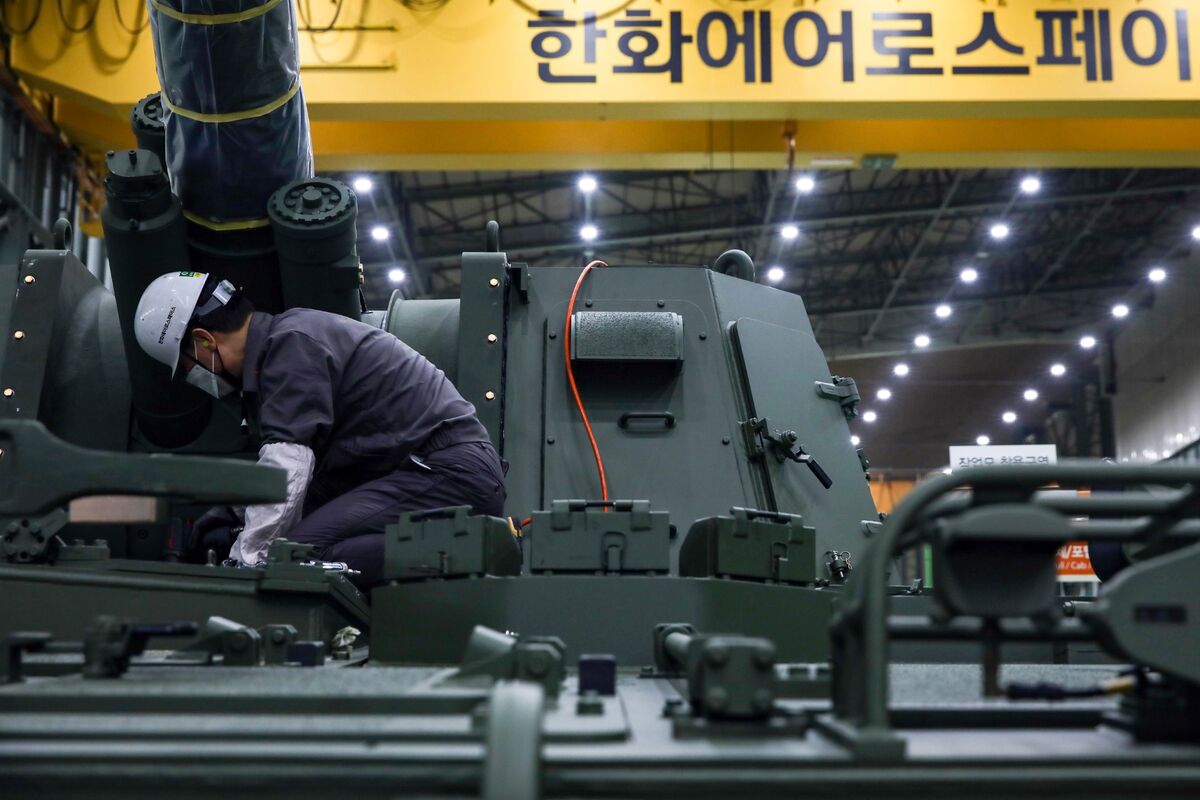
Ingraham's team toured Hanwha's Plants 2 and 3 in Changwon, ground zero for K9 howitzer manufacturing. Defense Mirror reported that officials observed robotic welding on active production lines and examined both the K9MH wheeled variant and the K9A1 tracked model through live mobility tests. Changwon produces K9s for South Korea, Poland, Australia, and Egypt—a track record that matters to U.S. planners.
The wheeled K9MH is the centerpiece. It's a 155-millimeter howitzer that fires the same ammunition as U.S. artillery systems. MarketScreener emphasized that the U.S. Army is evaluating the K9MH as its primary candidate for the Mobile Tactical Cannon program, marking a potential shift in how America equips forward-deployed units.
A $262.9 Million Bet on South Korean Manufacturing
The contract Hanwha Defense USA signed is no small gesture. Bloomberg reported the deal provides $262.9 million to deliver 18 K9 prototypes over four years—roughly $14.6 million per unit. This isn't just a purchase. It's a statement that the U.S. Army sees South Korean industrial capacity as essential to meeting its modernization deadlines and artillery shortages.
The Mobile Tactical Cannon program frames the K9 as a complement to existing M777 towed howitzers. Defense Mirror noted that the initiative sits squarely within U.S. deterrence strategy on the Korean Peninsula and broader Indo-Pacific security concerns. Hanwha's Alabama integration and test facility will support U.S. operations as production scales.
Automation and Phased U.S. Production Shift
What struck the Army delegation was Hanwha's production discipline. MarketScreener highlighted the company's automated welding systems and mass manufacturing footprint as critical assets. U.S. officials see these capabilities as a model for scaling up American artillery output without waiting years to build new factories.
Hanwha signaled that localization is coming. Defense Mirror reported that the company's Alabama facility will expand its role as the Mobile Tactical Cannon program ramps up. This phased approach lets the U.S. test South Korean engineering in a controlled setting before committing to full domestic production. It's industrial strategy wrapped in alliance management.
Broader Defense Portfolio on Display
The Changwon visit wasn't just about howitzers. MarketScreener noted that Ingraham's team also examined Hanwha's wider defense catalog: Chunmoo multiple launch rocket systems, M-SAM air defense, L-SAM long-range surface-to-air missiles, Redback infantry fighting vehicles, and KVLS ammunition systems. The message was clear—Hanwha is a one-stop shop for U.S. modernization needs.
Officials framed the entire engagement around alliance strengthening and deterrence. Defense Mirror reported that discussions centered on expanding defense cooperation and fortifying the U.S.-South Korea bond amid rising regional tensions. For the Pentagon, investing in Hanwha's proven industrial base is faster and smarter than starting from scratch.
Sentiment
Mostly PositiveNEGATIVENEUTRALPOSITIVE
Publishers
17
Articles
16
Reach
33
A
AnonymousAuthor


