Lewes Train Derailment
Lewes passenger train derails, trapping 40 and causing major rail disruption
Key Points
Rail services around Lewes were disrupted, with no trains running between Brighton and Lewes, no service between Haywards Heath and Lewes, and no service between Seaford/Eastbourne and Lewes.
Travelers were advised to use alternative routes at no extra cost, including Southern services between Brighton and London Victoria, Thameslink between Brighton and London Victoria, Gatwick Express between Brighton and London Victoria, and London Underground connections to London terminals.
There are conflicting reports on how many carriages were affected; some outlets report three carriages overturned while others describe an eight-carriage derailment.
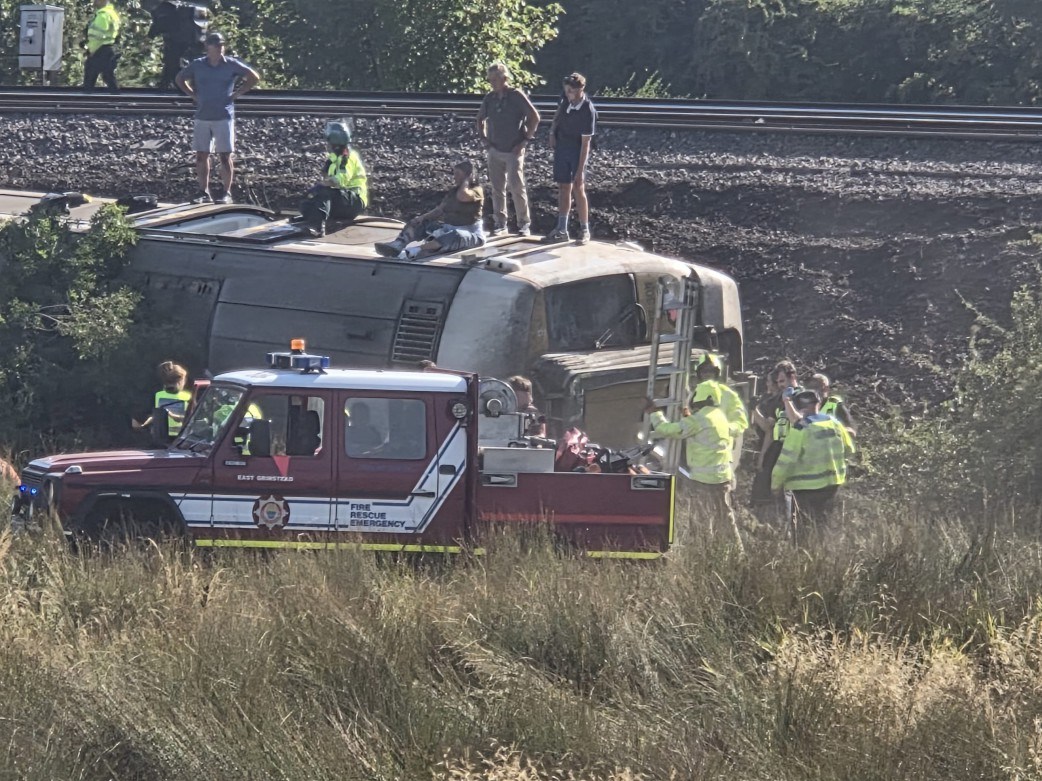
Eyewitness images described passengers climbing on top of the derailed train and being guided into a nearby field.
Emergency services, including the East Sussex Fire and Rescue Service, urged people to avoid the area as crews worked with police and paramedics.
A Southern passenger train derailed near Lewes railway station in East Sussex at 3:54 PM on August 13, trapping an estimated 40 people inside overturned carriages, according to CNN. The eight-carriage train came off the tracks on the East Coastway line, with two to three rear carriages flipping onto their sides. Eyewitness photos showed passengers climbing out of windows and standing on the roof before being guided into a nearby field.
Five helicopters and more than 20 road ambulances rushed to the scene, according to CNN. All lines through Lewes were shut, cutting off rail links between Brighton, Haywards Heath, Seaford, and Eastbourne. Disruption is expected to last until at least 10 PM. East Sussex Fire and Rescue Service urged the public to stay away from the area as crews worked alongside police and paramedics.
Extreme Heat Raises Questions About Track Buckling
The derailment struck on what may be the UK's hottest day of 2026. Temperatures climbed above 38°C (100°F) across the region. Steel rails in direct sunlight can reach 20°C hotter than the air around them. That means track temperatures near Lewes likely exceeded 58°C. Under that kind of heat, rails expand and can bend sideways — a phenomenon known as buckling.
Early social media posts blamed a landslide, but rail observers and engineering analysts pushed back. With no rainfall and extreme dry heat, a wet mudslide was highly unlikely. Photos circulating online appeared to show warped rails near the derailment site. The Rail Accident Investigation Branch (RAIB) — the UK's independent rail safety body — will determine whether buckled track caused the crash or was warped by the impact itself.
Rescue Operation and Political Response Move Fast
Emergency crews from South East Coast Ambulance Service (SECAMB), Sussex Police, and specialist rescue teams arrived by 4:15 PM. By 5:16 PM, five air ambulances were in the sky. Transport Secretary Heidi Alexander said she was "deeply concerned" and confirmed the government was "working quickly with the rail industry and local partners to assist passengers." Rail Minister Lord Hendy of Richmond Hill co-led the government's emergency response.
James MacCleary, the Liberal Democrat MP for Lewes, was on-site and called it a "very serious and developing incident." Helena Dollimore, Labour MP for Hastings and Rye, said it was "deeply distressing" and that the "thoughts of everyone are with those affected." The train drivers' union ASLEF urged the public to "allow the emergency services to do their job and refrain from speculation at this time."
Every Lewes Rail Route Shut — Here Are the Alternatives
Network Rail and Southern Rail declared a total shutdown of lines through Lewes. Three routes were closed: Brighton to Lewes, Haywards Heath to Lewes, and Seaford/Eastbourne to Lewes. Travelers were told to allow up to 60 minutes of extra time. Gatwick Airport passengers were warned to add at least 90 minutes to their journey — a serious issue during peak summer holiday season, according to KWWL.
Passengers were offered free travel on alternative routes at no extra cost. Options included Southern, Thameslink, and Gatwick Express services running between Brighton and London Victoria. London Underground connections at London terminals were also available. Local bus services were added as a backup. Disruption was expected to continue until around 10 PM.
Nationalized Rail Operator Faces Its First Major Crisis
The derailed train was operated by GTR — the parent of Southern Rail — which was brought into full public ownership on May 31, 2026, as part of Prime Minister Andy Burnham's rail nationalization program. GTR handles roughly one in six of all UK passenger rail journeys. The crash is the first major operational disaster for Burnham's government, which took office in July 2026.
The government had recently unveiled the first Great British Railways (GBR)-branded train in Brighton — making the Lewes disaster a direct test of its new public rail model. Critics are expected to question whether Network Rail and GTR took adequate precautions ahead of a heatwave that forecasters had widely predicted. The Carmont derailment in Scotland in 2020 — which killed three people and led to a £6.7 million fine for Network Rail — is already being cited as a warning that went unheeded on climate resilience.
Sentiment
Mostly NegativePublishers
40
Articles
57
Reach
97


