Next-Gen Shipbuilding Hub
Samsung Heavy and KAIST Open New Center for Future Shipbuilding Innovation
Key Points
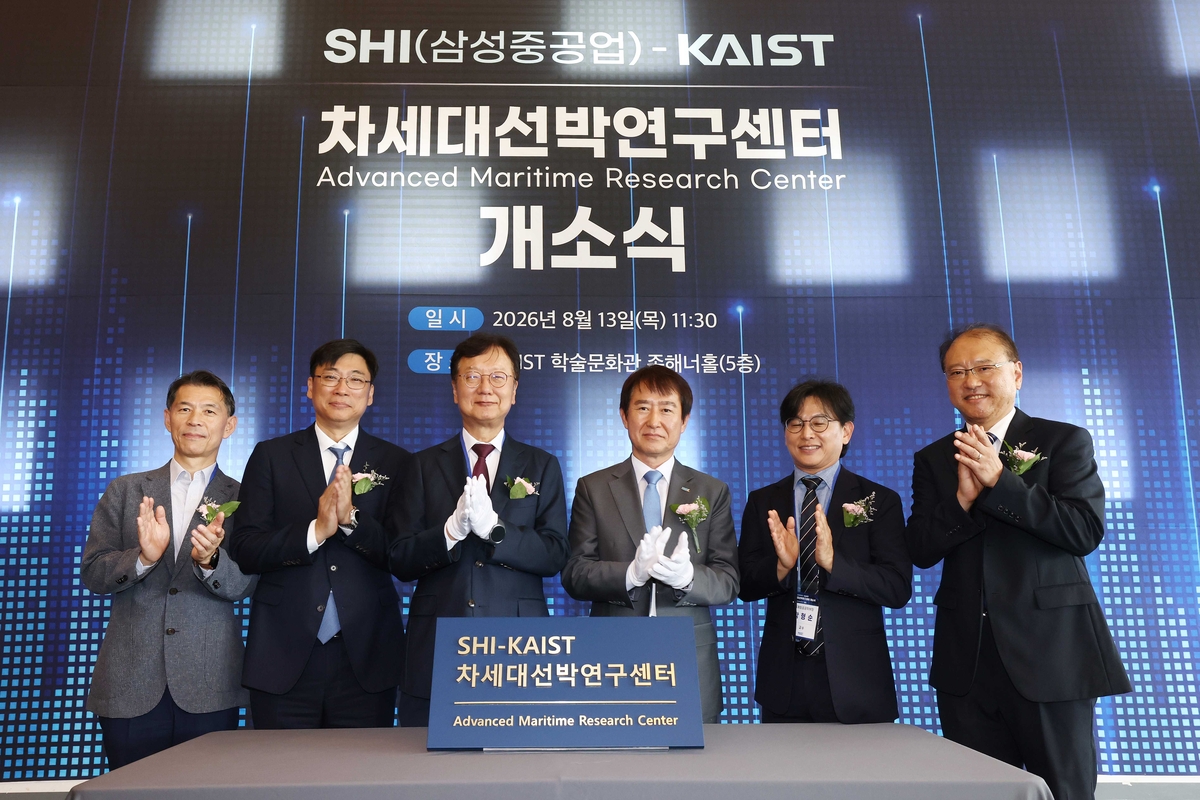
Samsung Heavy Industries Vice Chairman Choi Sung-an and KAIST President Bae Choong-sik attended the opening ceremony for the SHI-KAIST AMRC.
Student research support and scholarship programs will be funded through industry-academia cooperation funds as part of the AMRC partnership.
The eco-friendly propulsion track will target core equipment and fuel-supply technologies for vessels powered by ammonia, hydrogen and other fuels.
KAIST President Bae Choong-sik said, "The shipbuilding and offshore industry is a leading field where new value can be created through the convergence of mechanical engineering, AI and robotics."
Robotics work under the AMRC will include automating on-site processes such as welding, painting and inspection.
Samsung Heavy Industries and KAIST have opened the SHI-KAIST Advanced Maritime Research Center (AMRC) in Daejeon, South Korea, turning 32 years of on-and-off collaboration into a permanent research hub, according to Seoul Economic Daily. The center will target four areas: AI-powered autonomous navigation, zero- and low-carbon propulsion, smart shipyard manufacturing, and shipbuilding robotics.
Vice Chairman Choi Sung-an of Samsung Heavy Industries and KAIST President Bae Choong-sik attended the opening ceremony, according to Splash247. The partnership traces back to 1995 and includes roughly 1,000 joint activities — research projects, technical consulting, and more — over that span.
From One-Off Projects to a Permanent R&D Hub
Past Samsung Heavy–KAIST work was done project by project, with no standing structure to keep it going. The AMRC changes that. Seoul Economic Daily reports the center will run a continuous program — scanning for industry needs, then launching medium- to long-term research to meet them. That shift makes it easier to plan big bets on emerging technology.
The center will also fund student research and scholarships through industry-academia cooperation funds, according to BigGo Finance. The goal is to train specialists who can bridge the gap between the lab and the shipyard floor.
Clean Fuels and Zero-Carbon Ships on the Agenda
One of the AMRC's four research tracks focuses on eco-friendly propulsion. The team will develop core equipment and fuel-supply systems for vessels running on ammonia, hydrogen, and other low-emission fuels, according to Seoul Economic Daily. These alternative fuels are seen as the most likely path to decarbonizing the global shipping fleet.
The push matters commercially. Shipowners worldwide face tightening emissions rules, and South Korean builders like Samsung Heavy are racing to offer clean-fuel vessels before European and Chinese rivals do. Locking in the underlying technology now gives Samsung Heavy a head start, Splash247 notes.
Robots to Handle Welding, Painting, and Inspection
Shipbuilding is physically grueling and hard to automate. The AMRC will work to change that. Robotics research under the center will target on-site tasks like welding, painting, and inspection — jobs that are dangerous, repetitive, and costly when done by hand, according to Seoul Economic Daily.
The smart shipyard track ties directly to this. It will use digital-twin technology — a real-time virtual copy of the shipyard — to guide and optimize manufacturing on the ground. Together, robots and digital twins could cut errors and labor costs at the same time.
Leaders See AI and Robotics as Shipbuilding's New Edge
KAIST President Bae Choong-sik framed the stakes clearly at the opening. "The shipbuilding and offshore industry is a leading field where new value can be created through the convergence of mechanical engineering, AI and robotics," he said, according to BigGo Finance. That framing puts the AMRC at the center of South Korea's broader push to lead the next era of maritime technology.
Samsung Heavy has long been one of the world's top three shipbuilders. The AMRC gives it a dedicated pipeline from academic research to commercial ships. With autonomous vessels, clean fuels, and smart factories all advancing at once, the center's timing looks deliberate — and urgent.
Sentiment
Mostly PositivePublishers
10
Articles
5
Reach
15


