UAE's AI Satellite Journey Begins
Emirates SkyCargo Transports UAE's First AI Satellite, Altair-1, to Los Angeles for Launch
Key Points
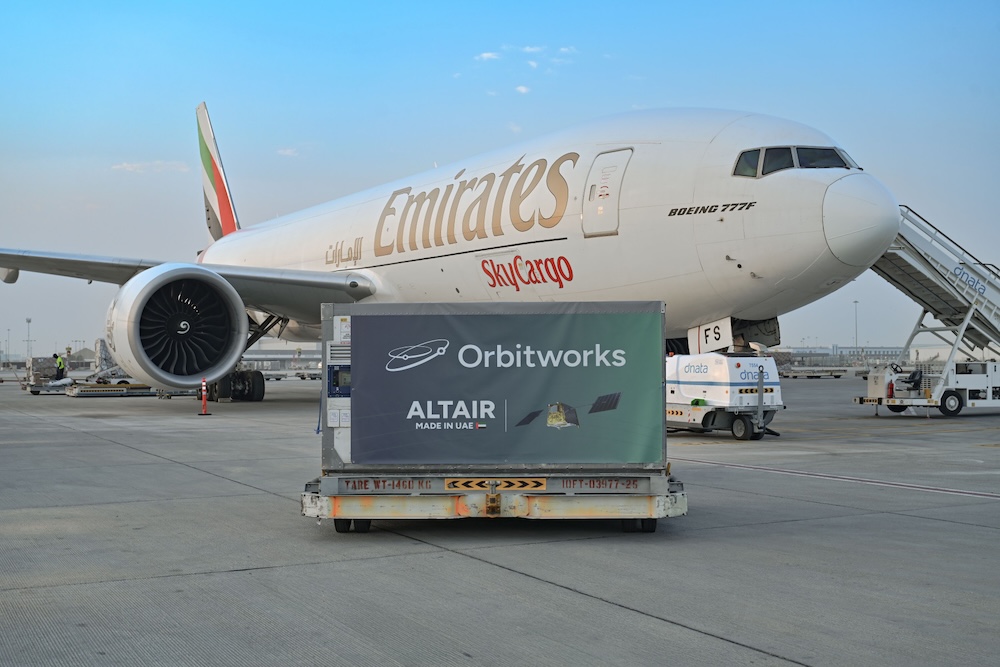
Altair-1 was transported from Dubai World Central (DWC) to Los Angeles International Airport (LAX) on a Boeing 777 freighter, with Emirates SkyCargo’s dedicated team overseeing the end-to-end flight.
Emirates SkyCargo has prior UAE-built satellite logistics experience, including Arab Satellite 813 to China and Khalifasat to South Korea in 2018; Khalifasat was the first satellite designed and built by UAE engineers.
In 2026, Emirates SkyCargo has transported more than 6,000 tonnes of aerospace and advanced engineering cargo worldwide.
The carrier expanded its freighter fleet in 2026, adding six Boeing 777F production freighters and one Boeing 777-300ERSF converted, with four more 777-Fs and one additional converted freighter due later this year.
Orbitworks’ Altair project is highlighted as a landmark achievement for both the company and the UAE, underscoring the strategic importance of the Altair constellation.
The UAE's first commercial AI-enabled Earth observation satellite has left the country it was built in. Emirates SkyCargo flew Altair-1 from Dubai World Central to Los Angeles International Airport on a Boeing 777 freighter, setting up an October 2026 launch, according to Tahawul Tech.
Altair-1 was developed and built in the UAE by Orbitworks. It is the first of 10 satellites in the Altair constellation, which will use optical, infrared, thermal, and radio-frequency sensors to deliver AI-processed data from orbit, Air Cargo Week reported.
What Altair-1 Will Do Once in Orbit
Altair-1 is not a simple camera in space. It carries multiple sensor types and runs AI processing onboard, meaning it can turn raw data into ready-to-use analysis before the information even reaches the ground. That cuts delivery time for critical insights, Logistics Middle East noted.
The constellation is built for real-world problems. Target uses include environmental monitoring, disaster response, maritime awareness, and infrastructure assessment. When all 10 satellites are flying, the Altair constellation will cover the Earth with far greater frequency than a single satellite can manage, according to Travels Dubai.
Emirates SkyCargo's Careful Handling of a Fragile Payload
Moving a satellite is not like shipping a car engine. Satellites are extremely sensitive to vibration, temperature changes, and static electricity. Emirates SkyCargo's Aerospace and Engineering team managed the full journey from start to finish, Air Cargo Week reported.
This is not the carrier's first time handling UAE-built space hardware. In 2018, Emirates SkyCargo transported Khalifasat to South Korea — the first satellite designed and built entirely by UAE engineers. It also shipped Arab Satellite 813 to China that same year, Dubai City Guide noted.
Emirates SkyCargo's Fleet Grows as Aerospace Cargo Booms
Emirates SkyCargo has moved more than 6,000 tonnes of aerospace and advanced engineering cargo worldwide in 2026 alone, according to Logistics Middle East. That volume reflects a growing global appetite for specialized freight services.
The carrier is scaling up to meet that demand. In 2026 it added six new Boeing 777F production freighters and one Boeing 777-300ERSF converted freighter to its fleet. Four more 777-Fs and one additional converted freighter are still expected before year's end, Tahawul Tech reported.
A Milestone Moment for UAE's Space Ambitions
Orbitworks called the Altair project a landmark achievement for the UAE. The company positions the constellation as a cornerstone of the country's goal to become a global hub for innovation and advanced technology, according to Air Cargo Week.
With Altair-1 now in Los Angeles ahead of its October launch, the clock is running. If all goes to plan, nine more satellites will follow. The UAE would then operate a full commercial AI-driven Earth observation network — something few countries have managed to build, Dubai City Guide noted.
Sentiment
Mostly PositivePublishers
13
Articles
1
Reach
14