Identity Decision Audit Failures
Global Study Finds Most Organizations Struggle to Defend Identity Verification Decisions
Anonymous
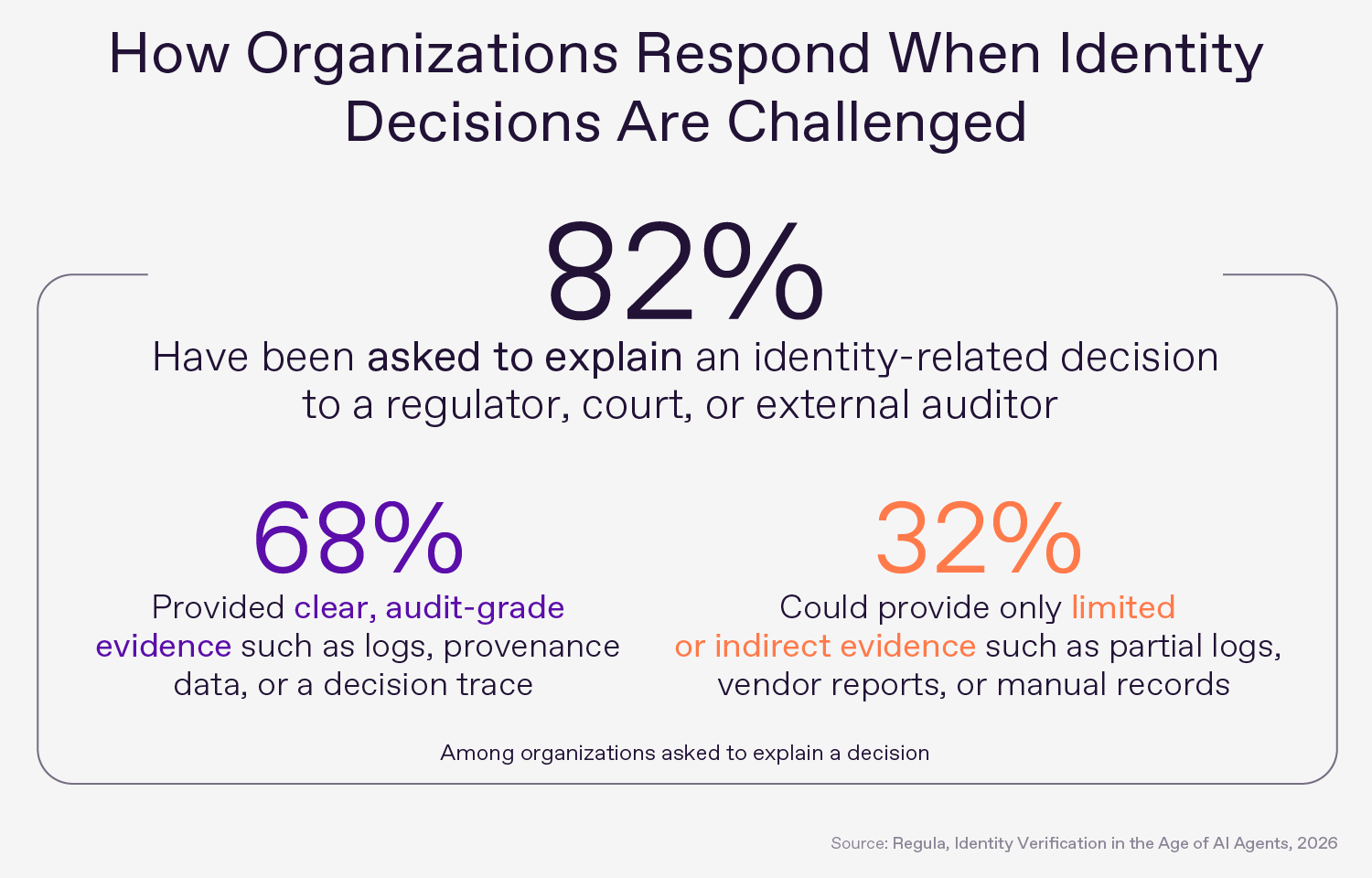
Four out of five organizations have been forced to explain an identity-related decision to regulators, courts, or auditors. Yet nearly one-third could only provide limited or indirect evidence to back up those decisions, according to a global study by Sapio Research. As identity verification becomes embedded in regulated financial, government, and online services, the inability to defend these choices is becoming a major compliance risk.
The core problem: most companies use fragmented identity systems from different vendors that don't talk to each other or keep detailed records. Only half of organizations can fully reconstruct how an identity decision was made across all contributing systems and data points. Forty-two percent can identify which systems were involved but cannot explain how the final decision actually happened.
The Audit Trail Gap Across Enterprise Systems
The study surveyed 850 senior decision-makers in fraud prevention, risk management, and compliance across the U.S., UK, Germany, Singapore, UAE, Brazil, and Mexico. These leaders work in banking, financial services, crypto, telecom, government, and online gaming—all highly regulated sectors. The data reveals a stark disconnect: while 82% faced formal audits or legal demands to document identity decisions, their systems were simply not built to preserve that evidence.
Modern identity verification chains multiple point solutions together: biometric liveness checks, document scanning, device intelligence, and database lookups. Each system operates in isolation, often without logging raw forensic data or decision rationale. When regulators or courts ask 'Why did you approve this person?' or 'How did you determine this identity was fraudulent?', organizations lack a unified record to answer credibly. This architectural fragmentation is not accidental—most platforms were built for periodic human reviews, not real-time AI-driven threats.
Critical Vulnerabilities in Biometric and Signal Verification
Beyond incomplete audit trails, organizations face deeper technical blind spots. Fifty-two percent cannot fully verify whether biometric inputs—like facial recognition or fingerprints—were captured live or injected from stored data. Forty-one percent cannot assess whether underlying identity signals were digitally manipulated. These gaps are especially dangerous as deepfakes and synthetic identities become more convincing.
The rise of AI agents and automated fraud bots has accelerated these concerns. Forty-seven percent of enterprise fraud prevention strategies now explicitly account for threats posed by AI-driven attacks and automated scripts. Organizations realize that traditional identity checks designed to stop humans cannot detect or explain how automated adversaries bypass their systems. Without forensic proof of what happened, regulators may assume negligence even when fraud was technically sophisticated.
Regulatory Exposure and Investigative Friction
When organizations cannot produce immutable proof explaining why a user was approved or rejected, they face severe penalties and reputational damage in regulatory inquiries or civil litigation. A bank denied a customer's loan based on identity verification? Without a detailed audit trail, the customer can claim discrimination. A crypto platform blocked an account for fraud? Inability to show forensic evidence invites legal challenges and regulator sanctions.
Internal fraud teams also lose time investigating complex schemes because telemetry signals remain locked in separate vendor dashboards. Piecing together evidence from multiple systems to spot a fraud ring or resolve a dispute takes weeks instead of days. This investigative friction inflates compliance costs and delays response to evolving threats.
The Shift Toward Connected and Continuous Assurance
Identity verification is moving away from isolated point-in-time checks toward lifecycle-wide evidence preservation. Solutions that capture and store full technical decision payloads—connecting document, biometric, contextual risk, and AI signals into unified audit trails—are becoming essential. Organizations that rebuild their identity stacks to log forensic data across all decision nodes gain both compliance defensibility and faster fraud investigation.
The 32% of organizations that could not defend their identity decisions face a choice: invest in consolidated identity platforms capable of real-time explainability, or accept growing legal and regulatory exposure. As deepfakes and AI threats accelerate, the ability to prove how and why an identity decision was made is no longer optional—it is foundational to operating in regulated industries.
Sentiment
NeutralNEGATIVENEUTRALPOSITIVE
Publishers
27
Articles
26
Reach
27
A
AnonymousAuthor