Decagonal Wave Circles Saturn's South Pole
Decagonal Wave Circles Saturn's South Pole
Anonymous
Key Points
1
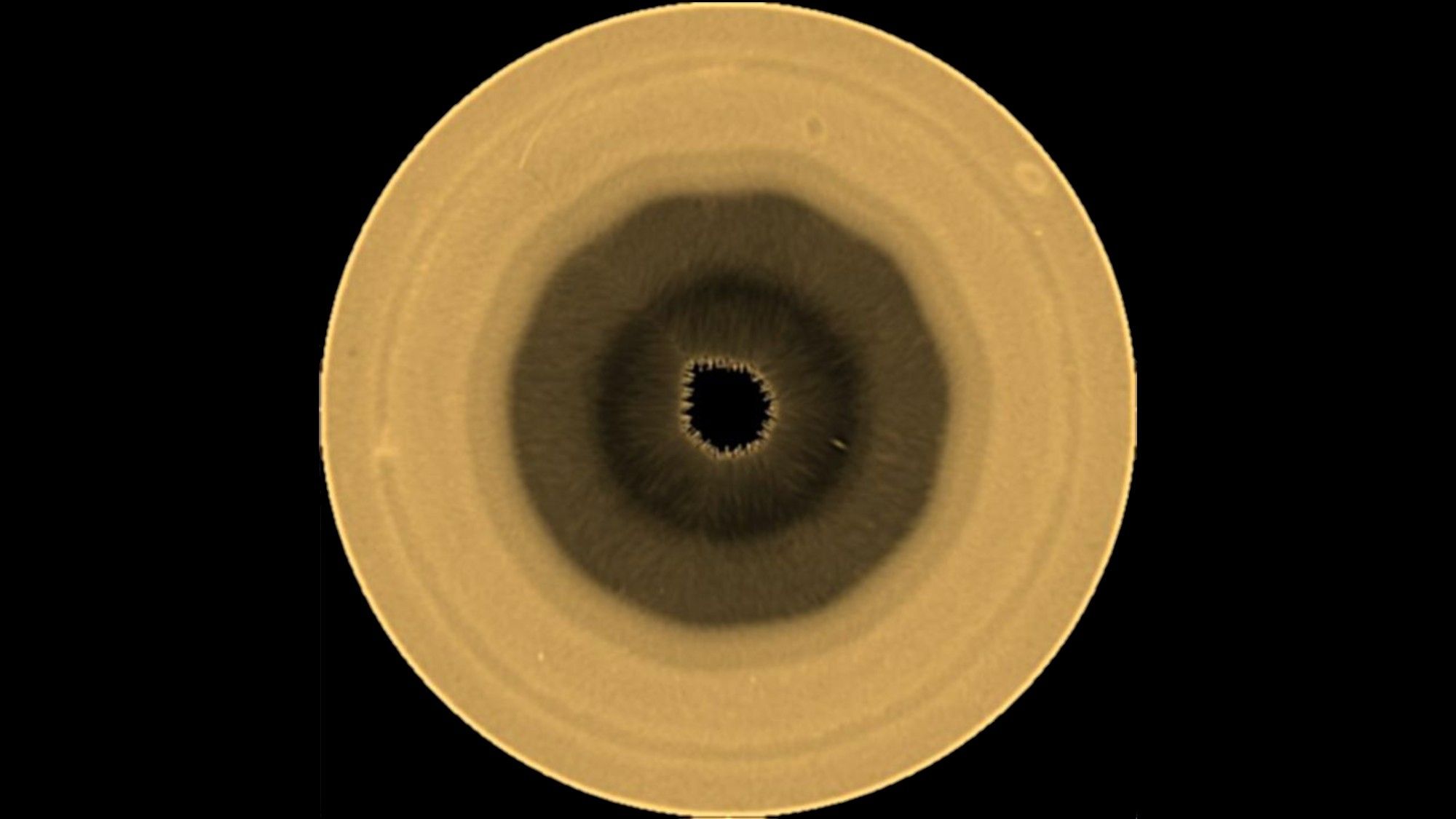
The south-pole decagon likely formed while Saturn’s south pole was out of view, with the phenomenon developing between 2017 and 2023 and only coming into view in 2023.
2
Over the following years the decagon evolved from a faint appearance in 2023 to a clear, ten-vertex pattern by 2025, with all ten vertices fully formed by August–September 2025, though brightness around the rim remains uneven.
3
The feature sits near 63°S latitude, highlighting a latitudinally localized, hemisphere-specific polygonal wave in Saturn’s atmosphere.
4
Cassini-era data from 2004–2017 did not reveal any hint of a long-lived south-pole polygon, suggesting this decagon is a newly developing phenomenon.
5
At least one side of the decagon already exceeds 10,000 miles (about 16,700 kilometers) in length, underscoring the scale of the feature.
Saturn's south pole harbors a giant 10-sided wave pattern in its icy clouds, a feature far larger and more dynamic than the familiar hexagon at the north pole. NASA scientists using the Hubble Space Telescope spotted the decagon in 2023 after Saturn's south pole rotated back into view, with one side already stretching beyond 10,000 miles in length. The discovery challenges the idea that Saturn's hexagon is unique and suggests gas giants routinely spawn these strange polygonal shapes.
The decagon likely formed while astronomers couldn't see it between 2017 and 2023. By 2025, all ten vertices had fully developed, making it a far clearer and more imposing feature than when first observed. Unlike the stationary north hexagon, this southern pattern drifts eastward at about 6 mph, revealing key differences in how Saturn's two hemispheres behave.
A Ten-Sided Giant Emerges From the South Pole
NASA's Hubble observations first caught the decagon in 2023, faint but undeniable against the ammonia ice clouds. The feature sits at about 63 degrees south latitude—a specific band where intense winds shape the planet's weather. Over the next two years, the pattern grew sharper and more defined, with all ten vertices locking into place by late 2025. Researchers say prior Cassini spacecraft data from 2004 to 2017 found no trace of any long-lived south-pole polygon, making this decagon a freshly developing phenomenon.
Why Saturn Favors Geometric Cloud Patterns
Scientists have long puzzled over why Saturn's north pole hosts a six-sided hexagon stable for decades. The new decagon suggests these shapes aren't anomalies but part of a broader class of wind-driven patterns on gas giants. Agustín Sánchez-Lavega and his Spanish-led team, along with Leigh Fletcher, believe the planet's jet streams naturally organize into polygonal formations. The exact mechanisms remain unclear, but the findings hint that such geometric waves may be far more common than previously thought.
Drifting Decagon Moves Faster Than the Stationary Hexagon
The decagon's behavior starkly differs from its northern cousin. While the hexagon remains locked in place, the southern decagon drifts steadily eastward at roughly 6 mph. This drift suggests the two hemispheres operate under distinct atmospheric rules. Science Advances published the findings as part of NASA and ESA's Hubble Outer Planet Atmospheres Legacy program, which monitors Saturn's weather patterns over years and decades. The ongoing evolution of the decagon will help researchers understand what forces create and sustain these extraordinary shapes.
One Edge Already Spans 10,000 Miles Across
The decagon's sheer scale underscores how powerful Saturn's winds are. At least one side already measures more than 10,000 miles—roughly the full width of Earth. The feature emerged from ammonia ice clouds swirling around the planet's south pole. Researchers note that brightness around the decagon's rim remains uneven in 2025, suggesting it is still settling into its final form. Questions linger about why polygons take exactly six or ten sides, what triggers their birth, and whether they eventually vanish or persist like the north hexagon.
Sentiment
Mostly NegativeNEGATIVENEUTRALPOSITIVE
Publishers
15
Articles
113
Reach
128
A
AnonymousAuthor


